Types of Plan in Engineering Drawing
1. Introduction
A edifice plan may be defined as the graphical or symbolic representation of how a building will wait later on completion of construction.
It is extensively used by Architects, Engineers, and Contractors in the construction industry.
A building plan tin can human action equally a medium of advice between the diverse parties involved in the construction as it can depict the concept and design of the building to be constructed.
The primary objective of the edifice programme is to provide an idea of the entire building construction. It is also essential in estimating the total budget required for the construction.
ii. Main Purposes of Edifice Plan
The major purposes served past the building plan can exist listed every bit follows:
a. It helps to visualize the outcome every bit information technology depicts how the building volition look like upon completion.
b. It acts every bit a medium of advice between the involved parties. (Building a plan can likewise assistance to communicate the ideas to the Customer.)
c. It helps to sympathise the concept, requirements, and telescopic of works.
d. It tin be used for estimating the cost required for the construction work.
e. It helps to make the changes and adjustments hands.
f. It can too assist in the selection of suitable materials for the construction.
g. It ensures efficient planning and use of the available space.
h. It helps in the preparation of 3D drawings.
3. Types of Edifice Plan
The edifice plans tin can exist divided into the following types:
a. Site Plan
The site plan can be defined as the big-scale drawing that depicts the overall extent of a site for the construction of new structures or the evolution of the existing structures.
In simple terms, the site plan is the symbolic representation of the arrangement of a building and the associated utilities in a site.
The site plan essentially includes the property lines, existing boundaries, access to the site, and all the existing nearby structures that must be considered during the design.
It represents the top view of a property within a site suitably drawn to scale.
The site plan must also conspicuously depict the existing household connections, service connections, and utilities such as water supply lines, drainage lines, sewer lines, clandestine cables, electrical lines, advice cables, etc.
Thus, the site plan includes a set of construction drawings that are necessary for the planning, improvement, and development of a site or property.

The site programme must be fabricated post-obit the existing bye-laws and local development codes. This is because the site plan besides serves as a legal understanding for the permission of the structure from the concerned regime.
i. Suitable Calibration for Training of Site Programme
The selection of scale for preparing the site plan is more often than not done based on the size of the project.
In most cases, the calibration of the site plans ranges from 1:500 to 1:200.
Information technology is a common practice to use pocket-size scales for large projects and large scales for small projects.
2. Elements Depicted in a Site Programme
The major elements that are shown in a site plan tin be enlisted as follows:
a. Boundary lines and the property lines.
b. Clear outlines of the proposed structures and buildings equally well as the outlines of any existing structure.
c. Distance between the proposed construction and other bordering and nearby structures.
d. The setbacks (i.e. the distance of the proposed structure to the belongings line.)
e. The parking spaces, parking lots, and driveways.
f. Adjoining and nearby streets and roads.
k. Existing utility and service lines.
iii. Information to be Included in Site Plan
The post-obit information must be included in a site plan:
a. The title cake comprising the proper noun of the project, type of the drawing, name of the person who prepared the plan, the status of the project, revision number, and the scale used for the drawing.
b. In case of revisions; notes depicting the changes made must be included. The notes are usually highlighted.
c. The directional orientation i.due east. northward pointing pointer must be shown.
d. The dimensions of the drawings must exist included.
e. The chief materials used tin also exist included.
f. The property lines or the boundaries of the site along with the adjoining streets and properties must be shown.
1000. The location of the site for the proposed construction must be indicated apropos the surroundings.
h. Existing copse, plants, or whatever environmentally essential elements, or restricted spaces such as public plantations must be included.
i. The parking space with articulate dimensions along with the traffic period and related signs must exist shown.
j. The existing streets, roads, pavements along with the easements such as the right of way, right of back up, etc must be included.
iv. Boosted Information Included in Site Plan
More often than not, when the site of the proposed construction is complex, additional information must exist included in the site programme.
The general site plan may be prepared along with the structural plan of the site, site lines, site history, landscaping drawings, existing topography, and geology, etc.
Some of the boosted information that can exist included in the site plan are as follows:
a. Any existing holding or building which has to exist demolished must be included in the site program.
b. The layout of the existing utility lines and service lines such as drainage lines, sewer lines, electricity cables, etc must be shown.
c. The extent of excavation and earthworks necessary including the cutting and filling must be included.
d. The fencings, gates, walls, and other external elements such as burn down hydrants, municipal litter bins, etc, if whatsoever can be included in the site plan.
b. Flooring Plan
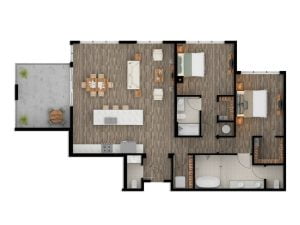
The floor programme tin be defined as a drawing sized to a suitable calibration such that the positions and orientations of the rooms, utilities, equipment, and article of furniture are depicted clearly from in a higher place i.due east. from a bird'due south center view.
The floor plan is the top view of the floor of a building or any construction and is regarded every bit the most fundamental architectural drawing.
The flooring plan is a ii-dimensional representation of the floors of a building including the sizes and details.
Designers, Engineers, Contractors, and Architects use the floor plans extensively to represent the organization of the available floor spaces within a edifice.
Precisely, the floor plan can exist divers every bit the vertical orthographic projection of an object in a horizontal plane cutting through the building such that the walls, windows, doors, and other elements such as furniture, stairs, etc inside a floor of the building are included.
i. Elements of a Floor Plan
The major elements of a floor plan tin can be described in brief as follows:
a. Dimensions and Dimension Lines:
Dimensions and dimension lines are the essential elements of a flooring plan that represent the size of the items in reality. For instance; the length of the doors and windows, size of rooms, etc.
b. Calibration:
Scale can range from plan to program.
Scale refers to the factor that represents the extent to which the whole infinite can fit on the paper or the screen.
In most cases, the scale ratio of 1/4 inches equal to 1 foot is taken. This indicates that the length of ane/4 inches in the cartoon represents a length of 1 human foot in reality.
c. Types of Rooms and Accessories:
A typical floor plan represents the walls, windows, stairs, lobby, piece of furniture, etc.
ii. Importance of a Flooring Plan
The major importance of the floor plan can exist duly listed as follows:
a. It acts equally a medium to communicate ideas regarding how the bachelor space can be utilized within the building.
b. It besides depicts the scope of works required and the scale of the project.
c. It can be used for interior designing and layout.
iii. Steps in the Preparation of Floor Plan
The primary steps involved in the training of a floor programme can be listed equally follows:
a. Selection of Suitable Area:
Outset of all, the target expanse must be decided based on the number of areas required, the required size of the rooms, required shape, etc.
b. Listing of Requirements:
The essential needs and requirements must be listed.
c. Measurement of the Components:
All the essential components such as the walls, doors, windows, and other similar components must be measured or their dimensions must be adamant.
d. Drafting of the Programme:
Then, the draft cartoon of the proposed structure must be prepared i.due east. the framework of the structure must exist prepared. And so, the other essential components tin can be added.
e. Addition of other Elements:
After drafting, boosted elements such every bit furniture, equipment, etc must be added.
f. Checking of the Floor Plan:
One time the drafting of the floor plan is completed, it must be checked with the listed requirements, provided accessibility, etc.
iv. Things to be Considered for Drafting Floor Plan
The things to be considered while designing and drafting the floor program are as follows:
a. The design must be done such that the usage of the room tin be changed in the future if required.
b. The design must exist flexible such that whatever changes in blueprint in the future can be easily incorporated
c. The design of the flooring plan must comply with the codal provisions and by-laws.
d. The design of the floor plan must be practical and functional. For example, the bathrooms must be placed at a sufficient distance from the kitchen and dining rooms.
v. Types of Floor Plan
The floor programme tin can be farther divided into the following categories:
one. Firm Plan:
As the name itself implies, a house plan may be defined as the type of floor plan that essentially comprises the construction drawings indicating the layout of a residential edifice. The House programme is also referred to as the home plan.
2. Office Plan/Layout:
The office layout is the type of flooring plan that represents the meridian view of the office space or working space within a building.
Different types of function layout that are commonly used are as follows:
a. Cubicle Type Office Programme/Layout:
It is the type of layout in which the partitioning walls are arranged on three sides of the space to form a cubicle. This type of office plan is generally used by private companies.
b. Team Type Office Plan/Layout:
Squad blazon of part plan is the type of floor plan in which the entire space is divided into respective departments. The size of each department is determined based on the number of employees in a particular section.
c. Open Type Office Plan/Layout:
It is the blazon of floor plan in which the entire infinite is utilized for the seating of employees by placing a lounge seating unit of measurement.
3. Garden Program:
Garden plan is becoming very popular these days. Information technology includes a bird'south middle view of the landscaping and planting arrangements.
4. Fire and Emergency Programme:
Fire and emergency programme is the pinnacle view representation of the emergency evacuation plan in the issue of a fire.
five. Seating Program:
Seating plan is mostly used for the construction of auditoriums, theatres, etc. It refers to the peak view representation of the seating arrangement within an enclosed space.
vi. Limitations of a Floor Plan
The limitations of a floor programme can be listed as follows:
a. Information technology does not give any information regarding the necessary construction works in detail.
b. It does non provides complete technical information as that required for the structure planners, managers, and engineers. Such as adequate technical information regarding the civil works, plumbing works, etc.
c. Exclusive Drawing
Sectional cartoon is the symbolic representation of how the edifice will wait if it is sliced in half or is cut along a certain plane.
Information technology is necessary to sympathise the interrelation between the various components of a building which cannot be interpreted conspicuously from a elementary flooring plan.
The imaginary plane forth which the building is cutting is generally referred to every bit the section aeroplane.
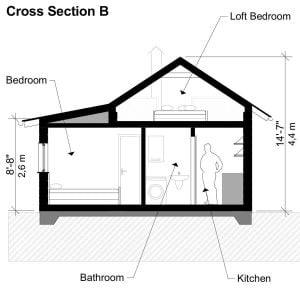
Section plane is represented utilizing a line comprising of a serial of long and short dashes.
In case, more 1 sectional plane is present then each of the sectional planes is represented by a particular number or alphabets at either terminate of the line.
i. Scale for Sectional Drawing
The appropriate scale for the sectional cartoon is selected based on the overall size of the building. However, the sectional drawing can include the consummate edifice or a particular part or component of a building, or an associates of components.
ii. Purposes of Exclusive Drawing
The major purposes of exclusive cartoon can exist listed as follows:
a. It is essential to get a articulate understanding of a particular section of the edifice.
b. It helps to sympathise the internal details of a component or building section. Such as sectional drawings of walls can describe the internal cuts of the gypsum boards, plates, studs, and insulation.
c. It tin can exist used to know almost the materials to be used and the assembly of the materials.
d. Superlative
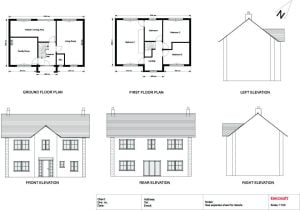
Superlative can be defined every bit the orthographic projection of a particular side of the building.
Elevation depicts the representation of a side of the proposed building, for instance, if the peak represents the southern side of the building, it is known as the Due south elevation.
The primary objective of preparing the elevation of buildings is to have an idea near how the particular side of the building will wait after it has been completed (i.east. it depicts the finished advent of the detail side of the building ).
The superlative is drafted based on the vertical height dimensions of the building.
i. Types of Elevation
The elevation tin exist divided into the post-obit types:
a. External Elevation:
The external peak is the symbolic representation of the outer side of the building.
It substantially includes the type of finish of the outside of the building, any existing projections, and the floor height.
External top tin be represented in 2D or 3D view.
It tin also provide information regarding the dissimilar materials to be used in the various components of the building. At that place are iv types of external elevation:
i. Northward Elevation
ii. East Height
iii. South Elevation
4. West Peak
b. Internal Elevation:
Interior pinnacle is the symbolic representation of the interior portion of a building.
Usually, the interior tiptop is used for the designing and structure of the kitchens, living rooms, etc that require the pre-visualization of the interior components.
Interior elevations provide the details of the interior space along with the piece of furniture details, type of lightings, type of paints, etc.
Mostly, internal elevations are represented in 3D view.
due east. Landscape Plan
The mural program is used to represent the exterior open space of the building from a bird's center view.
Usually, the landscape plan is used for the architecturally of import structures.


Educational Platform Nether Naba Buddha Institute
Source: https://dreamcivil.com/building-plan/
0 Response to "Types of Plan in Engineering Drawing"
Post a Comment